Back to Top
Apply Giving myAugusta
Resources for:
Students
Students Faculty & Staff Parents & Family Alumni Community
Augusta University Logo
  • Academics
    Graduates pose together in their regalia.
    Augusta University celebrates fall 2025 graduates »

    Academics Home

    Colleges & Schools

    Programs of Study
    • Degrees & Programs
    • Course Catalog
    • Course Schedule
    • Program Pathways
    • Academic Calendar
    • Online Programs
    • Accelerated Degree Programs
    Resources
    • Academic Success Center
    • Advising
    • Counseling Services
    • Honors Program
    • Libraries
    • Testing & Disability Services
    • Writing Center
    Outside the Classroom
    • Army ROTC
    • Study Abroad
    • Experiential Learning
    • First Year Experience
    • Center for Undergraduate Research
    • Career Services
    • Jags Live Well
  • Admissions
    Augusta University's jaguar mascot, Augustus, and two students hold their hands like a paw
    Augusta University awarded $1.3 million grant to expand student support »

    Admissions Home

    Visit Campus

    Request Information

    Apply to AU
    • First-Year Freshmen
    • Transfer Students
    • Dual Enrollment
    • Graduate Students
    • Medical College of Georgia
    • Dental College of Georgia
    Opportunities
    • Degree & Programs
    • Honors Program
    • Program Pathways
    • Military-Affiliated Students
    • New Student & Family Transistions
    • On-Campus Housing
    Financial Aid
    • Student Financial Aid
    • Net Price Calculator
    • Scholarships
    • Cost of Attendance
    • Apply for Federal Aid
  • Campus Life
    President Keen and First Lady stand with students to cut ribbon on outdoor rec center
    Center for Outdoor Recreation and Education celebrates grand opening »

    Campus Life Home

    Athletics

    Community
    • Army ROTC
    • Living-Learning Communities
    • Military & Veteran Services
    • Mentorship
    • New Student & Family Transistions
    • Jags 4 Jags Mentoring Program
    Campus Services
    • Dining Services
    • Roarstore
    • Housing
    • Student Health
    • Parking & Transportation
    • Jagcard
    Get Involved
    • Clubs & Organizations
    • Greek Life
    • Campus Recreation
    • Student Government
    • Jaguar Production Crew
    • Intramural Sports
  • Research
    Three men in suits stand in front of a Augusta University Medical College of Georgia backdrop and smile at the camera. The man in the middle is holding a plaque.
    MCG scientists investigate arthritis drug’s impact on Alzheimer’s disease »

    Research Home

    Opportunities
    • Undergraduate Research
    • Graduate & Postdoctoral Research
    • Clinical Trials
    • Core Laboratories
    • Innovation Commercialization
    Initiatives
    • Cancer
    • Cardiovascular
    • Immunology
    • Neuroscience
    • Aging
    Resources
    • Centers & Institutes
    • Ethics & Compliance
    • Institutional Review Board
    • Sponsored Programs
    • Tools for Researchers
  • About AU
    Five women and two men jump and raise their hands in celebration.
    AU contributed over $1.6 billion to Georgia’s economy in FY 2024 »

    About AU

    Jagwire News

    Leadership
    • President
    • Provost
    • Administration
    • Enrollment Student Affairs
    • Faculty Senate
    We are AU!
    • Our Mission
    • Working at AU
    • Traditions
    • History
    • Augusta, GA
    Resources
    • MyAugusta
    • Calendar of Events
    • Brand Guidelines
    • Portals
    • Faculty Directory
Resources For
  • Current Students
  • Faculty & Staff
  • Parents & Family
  • Alumni & Friends
Apply
Giving
MyAugusta
Trending Search Terms
  • D2L LMS
  • Email
  • Pounce
  • Calendar
  • Registrar
  • Housing
  • Academic Calendar
  • Financial Aid
  • Parking
  • Library
  • Human Resources
  • Information Technology
Medical College of GeorgiaHamesNet | DF&CM Research
HamesNet | DF&CM Research
  • Our Approach
  • Our Organization
  • Our Work
    • Explore our Work
    • Research to Practice
  • Augusta University
  • Colleges & Schools
  • Medical College of Georgia
  • Family & Community Medicine
  • Research | Family & Community Medicine
  • HamesNet | DF&CM Research
  • Curtis G. Hames, the Scholar

Curtis G. Hames Sr, MD the Scholar

Dr. Curtis G. Hames, Sr.'s clinical observations of the occurrence of coronary artery disease in his clinical practice were evaluated in the historic Evans County Heart Study. This was the first National Institutes of Health-sponsored epidemiological project to evaluate cardiovascular disease in the entire population of a bi-racially diverse community.

Ledger Cover

NIH's Dr. James Watt and Dr. Jeremiah Stamler of the Chicago Prevention and Evaluation Program recognized the potential of this community-based study proposal in Evans County, Ga., and Dr. Watt nurtured and expanded its scope. Dr. Hames secured the collaboration initially of Dr. John McDonough, a medical officer of the U.S. Public Health Service, the local Health Department, Dr. Glen E. Garrison of the U.S. Public Health Service and later the Department of Epidemiology and Biostatistics at the University of North Carolina School of Public Health. These collaborations directed the exploration of ethnic differences and causes of coronary artery disease in this small rural southern community and provided study design, and statistical, evaluation and administrative support as well as a funding mechanism.

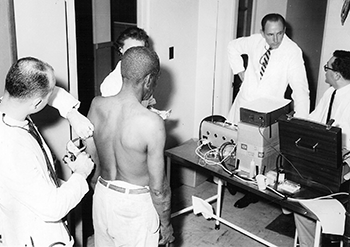
The Evans County Heart Study began in 1959 when Dr. McDonough initiated a private census of Evans County to determine eligible residents for the study. The goal of the census was to identify all county residents above the age of 40 and a 50% sample of county residents between the ages of 15 and 39. Ninety- two percent(3,102) of eligible residents agreed to participate in the study and received a physical examination, a 12-lead electrocardiogram, serum-cholesterol determination and other biochemical studies. Frozen serum was banked for future research studies. The high study participation rate and that of other follow-up studies of this cohort was based on the excellent rapport Dr. Hames had with the residents of his community. Dr. Garrison who later joined the faculty of the Medical College of Georgia, and Dr. McDonough who joined the departments of Medicine and Epidemiology and Biostatistics at UNC examined and evaluated all participants in the initial Evans County Heart Study. 
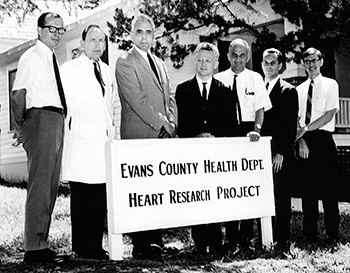
/evancohealthdeptpeople

Data collected and analyzed in the original Evans County Heart Study confirmed Dr. Hames' initial clinical observations. After examining several factors, Drs. Hames, McDonough and Garrison and other researchers from UNC suggested that social status and physical exercise may contribute to ethnic differences observed in coronary artery disease in the county. Drs. Cassel, H.A. Tyroler and others from UNC along with Dr. Hames postulated in follow-up studies behavioral and environmental determinants of serum cholesterol in families with different social and occupational strata in Evans County. Other funded studies of the original and living members of the cohort continued over an ensuing 37 years.

Questions that emerged from his clinical observations, his initiative to establish the Evans County Heart Study and other collaborations established Dr. Hames as one of the pioneers of practice-based research and its networks. The rich database of the Evans County Heart Study has been used nationally and internationally for collaborative research resulting in multiple authored publications and citations exploring subjects such as:
  • ptonscalePassive smoking and 20-year cardiovascular disease mortality among nonsmoking wives
  • Socioeconomic status and morbidity and mortality in hypertensive blacks
  • Urban and rural differences in cardiovascular disease in blacks
  • The impact of hypertension, hyperlipidemias, physical exercise, diet, stress, personality and population migration on the incidence of cardiovascular disease
  • Biochemical, endocrine and mineral effects in biracial populations and effects on cardiovascular disease
  • Mortality patterns in hypertension by reported levels of caffeine consumption
  • The role of trace elements, particularly selenium, in the American diet
  • Inflammation and heart disease
  • Cardiovascular disease and genetics
  • The association of cardiovascular disease with transitory ischemic neurological phenomena and stroke
  • CHF Prevalence
  • Charleston Heart Study

...Curtis G. Hames, Sr., M.D. the Physician
...Curtis G. Hames, Sr., M.D. the Humanitarian

For additional information on Dr. Hames, please visit the Curtis G. Hames, Sr., M.D. Papers, located in Historical Collections and Archives in the Robert B. Greenblatt, M.D. Library. The Papers were used in the development of the Curtis G. Hames, Sr., M.D. exhibit. Other sources from which information was drawn include:
McDonough JR, Hames CG, Stulb SC, Garrison, GE. “Cardiovascular disease field study in Evans County, GA”, Public Health Rep 1963;78:1051-59.
McDonough JR, Hames CG, Stulb SC, Garrison, GE. “Coronary heart disease on Negros and whites Evans County, GA”, Journal of Chronic Disease 1965;18:443-68.
Hames CG (Introduction), Cassell JC (guest editor and author). “Evans county cardiovascular and cerebrovascular epidemiologic study”. Archives of Internal Medicine 1971;128(6):883-95.
Green LA, Hickner J. ”A short history of primary care practice-based research networks: From concept to essential research laboratories". Journal of the American Board of Family Medicine 2006;19(1):1-10.
cover photo
University Shield

Augusta University

1120 15th Street, Augusta, GA 30912

  •   Campus Maps
  •   Campus Contacts
  • A-Z Directory
  • Degrees & Programs
  • Employment
  • Accessibility
  • Accreditation
  • Campus Safety
  • Compliance Hotline
  • Human Trafficking Notice
  • Privacy Notices
  • Title IX / Sexual Misconduct
Apply Now Give Now

© 2025 Augusta University

Facebook Twitter LinkedIn Youtube Instagram
©