Back to Top
Apply Giving myAugusta
Resources for:
Students
Students Faculty & Staff Parents & Family Alumni Community
Augusta University Logo
  • Academics
    Graduates pose together in their regalia.
    Augusta University celebrates fall 2025 graduates »

    Academics Home

    Colleges & Schools

    Programs of Study
    • Degrees & Programs
    • Course Catalog
    • Course Schedule
    • Program Pathways
    • Academic Calendar
    • Online Programs
    • Accelerated Degree Programs
    Resources
    • Academic Success Center
    • Advising
    • Counseling Services
    • Honors Program
    • Libraries
    • Testing & Disability Services
    • Writing Center
    Outside the Classroom
    • Army ROTC
    • Study Abroad
    • Experiential Learning
    • First Year Experience
    • Center for Undergraduate Research
    • Career Services
    • Jags Live Well
  • Admissions
    Augusta University's jaguar mascot, Augustus, and two students hold their hands like a paw
    Augusta University awarded $1.3 million grant to expand student support »

    Admissions Home

    Visit Campus

    Request Information

    Apply to AU
    • First-Year Freshmen
    • Transfer Students
    • Dual Enrollment
    • Graduate Students
    • Medical College of Georgia
    • Dental College of Georgia
    Opportunities
    • Degree & Programs
    • Honors Program
    • Program Pathways
    • Military-Affiliated Students
    • New Student & Family Transistions
    • On-Campus Housing
    Financial Aid
    • Student Financial Aid
    • Net Price Calculator
    • Scholarships
    • Cost of Attendance
    • Apply for Federal Aid
  • Campus Life
    President Keen and First Lady stand with students to cut ribbon on outdoor rec center
    Center for Outdoor Recreation and Education celebrates grand opening »

    Campus Life Home

    Athletics

    Community
    • Army ROTC
    • Living-Learning Communities
    • Military & Veteran Services
    • Mentorship
    • New Student & Family Transistions
    • Jags 4 Jags Mentoring Program
    Campus Services
    • Dining Services
    • Roarstore
    • Housing
    • Student Health
    • Parking & Transportation
    • Jagcard
    Get Involved
    • Clubs & Organizations
    • Greek Life
    • Campus Recreation
    • Student Government
    • Jaguar Production Crew
    • Intramural Sports
  • Research
    Three men in suits stand in front of a Augusta University Medical College of Georgia backdrop and smile at the camera. The man in the middle is holding a plaque.
    MCG scientists investigate arthritis drug’s impact on Alzheimer’s disease »

    Research Home

    Opportunities
    • Undergraduate Research
    • Graduate & Postdoctoral Research
    • Clinical Trials
    • Core Laboratories
    • Innovation Commercialization
    Initiatives
    • Cancer
    • Cardiovascular
    • Immunology
    • Neuroscience
    • Aging
    Resources
    • Centers & Institutes
    • Ethics & Compliance
    • Institutional Review Board
    • Sponsored Programs
    • Tools for Researchers
  • About AU
    Five women and two men jump and raise their hands in celebration.
    AU contributed over $1.6 billion to Georgia’s economy in FY 2024 »

    About AU

    Jagwire News

    Leadership
    • President
    • Provost
    • Administration
    • Enrollment Student Affairs
    • Faculty Senate
    We are AU!
    • Our Mission
    • Working at AU
    • Traditions
    • History
    • Augusta, GA
    Resources
    • MyAugusta
    • Calendar of Events
    • Brand Guidelines
    • Portals
    • Faculty Directory
Resources For
  • Current Students
  • Faculty & Staff
  • Parents & Family
  • Alumni & Friends
Apply
Giving
MyAugusta
Trending Search Terms
  • D2L LMS
  • Email
  • Pounce
  • Calendar
  • Registrar
  • Housing
  • Academic Calendar
  • Financial Aid
  • Parking
  • Library
  • Human Resources
  • Information Technology
Medical College of GeorgiaSelner's Rhinolaryngoscopy Online
Selner's Rhinolaryngoscopy Online
  • Home
  • Workbook Chapters
    • Introduction
    • 1. Upper Airway Diagnosis
    • 2. Examination Technique
    • 3. Normal Anatomy of the Upper Airway
    • 4. Upper Airway Pathology
  • Images & Annotations
    • Nasal cavity
    • Nasopharynx
    • Oropharynx
    • Larynx
  • Videos
  • iTunes
  • Augusta University
  • Colleges & Schools
  • Medical College of Georgia
  • Pediatrics
  • Allergy-Immunology Fellowship
  • Selner's Rhinolaryngoscopy Online
  • Selner's Rhinolaryngoscopy Online

Selner's Rhinolaryngoscopy Online

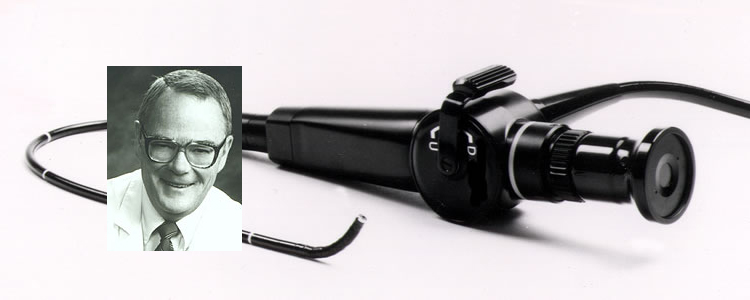
endoscope

John C. Selner, MD
William K. Dolen, MD
Bryan Spofford, MD
Jerald W. Koepke, MD

Endoscopic Images and Annotations - 3. The Oropharynx

Endoscopic Images and Annotations - 1. The Nasal Cavity
Endoscopic Images and Annotations - 2. The Nasopharynx
Endoscopic Images and Annotations - 4. The Larynx

Oropharynx
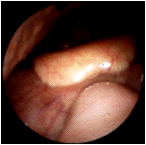
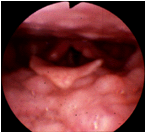
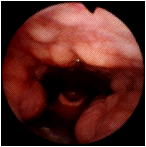
The oropharynx in a normal individual. The uvula at 5 o'clock is resting on the posterior tongue. The epiglottis can be seen above and slightly to the left in this view.

Prominent lingual tonsils.

Even larger lingual tonsils.

This is a 37 year old female who underwent adenoidectomy and palatine tonsillectomy at the age of 3 years. As an adult, she complained of a globus sensation and of having something which she could not swallow chronically stuck in her throat. Her symptoms were dismissed as neurotic. There is massive hypertrophy of the remaining lingual tonsils. The posterior oropharyngeal wall is at 12 o'clock, and the base of the tongue is at 6 o'clock. (Selner slide #45)

In this view, the endoscope is passed through the choana and is directed caudally from the left posterior nasal passage. At 12 o'clock is the posterior pharyngeal wall, and immediately posterior to this tissue are the vertebral bodies. The prominent ridge at 6 o'clock is the muscularis uvulae as seen from above. In the distance, one can see the tip of the epiglottis. Distances tend to be exaggerated by the wide viewing angle of the endoscope. (Selner slide #16)

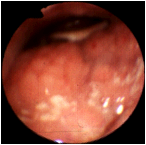
The base of the tongue is at the bottom of this image, and the posterior pharyngeal wall is at the top. The examiner can ask the patient to lean forward and protrude his tongue in order to obtain a clear view of the hypopharynx . This posterior tongue demonstrates the circumvallate papillae, which are the prominent pink nodules, and the whitish structures, which is keratin on the filiform papillae. Sometimes the white filiform papillae can be confused with Candida infection. (Selner slide #17)

Uvular granuloma, a potential premalignant lesion, which was not discernible on routine physical examination employing a tongue depressor. (Selner slide #40)

A patient with long standing chronic rhinosinusitis. The tip of the examining scope is in the nasopharynx, and is directed inferiorly. At 12 o'clock is the posterior pharyngeal wall. The tip of the epiglottis is seen in the distance in the center of the slide. Prominent lymphoid nodularity can be readily visualized on the posterior wall . The palatine tonsils protrude from the lateral walls at 4 o'clock and 9 o'clock. (Selner slide #41)

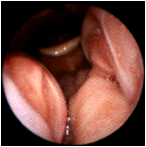
Significant enlargement of the palatine tonsils at 2 o'clock and 7 o'clock producing airway obstruction. The uvula is visible between the palatine tonsils. (Selner slide #42)

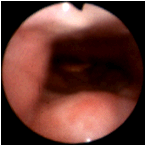
A child with a clinical history suggesting obstructive sleep apnea. The narrow airway caliber as seen in this view represents significant obstruction from hypertrophy or hyperplasia of the palatine tonsils. (Selner slide #43)

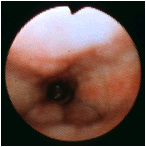
Pharyngeal spasm in a patient complaining of tightness of the throat due to exposure to copy machine chemicals and carbonless copy paper. The diameter of the oropharynx has been remarkably reduced by spasm of the pharyngeal constrictor muscles. At the base of the slide, the lingual tonsils are compressed. The epiglottis is barely visible, distal to the obstruction. (Selner slide #44)

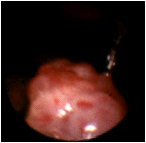
During the course of a viral illness, a 27 year old male began to experience a focal painful sensation in the back of the tongue. On the base of the tongue, there is an erythematous nodular lesion which appeared to be an inflamed, edematous circumvallate papilla. The lesion resolved spontaneously. (Selner slide #46)

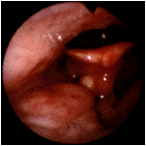
A 3 mm mucocele is visualized in the floor of the left vallecula; the lingual tonsil is located at 7 o'clock. Mucoceles are commonly located about the faucial arches and the epiglottis. This lesion did not require further investigation or treatment. Sometimes, though, a mucocele will become large enough to produce symptoms because of its size. Occasionally, a mucocele can become infected (mucopyocele). (Selner slide # 47)

In memoriam, John Canty Selner, MD (1936-2006)

University Shield

Augusta University

1120 15th Street, Augusta, GA 30912

  •   Campus Maps
  •   Campus Contacts
  • A-Z Directory
  • Degrees & Programs
  • Employment
  • Accessibility
  • Accreditation
  • Campus Safety
  • Compliance Hotline
  • Human Trafficking Notice
  • Privacy Notices
  • Title IX / Sexual Misconduct
Apply Now Give Now

© 2025 Augusta University

Facebook Twitter LinkedIn Youtube Instagram
©