Back to Top
Apply Giving myAugusta
Resources for:
Students
Students Faculty & Staff Parents & Family Alumni Community
Augusta University Logo
  • Academics
    Graduates pose together in their regalia.
    Augusta University celebrates fall 2025 graduates »

    Academics Home

    Colleges & Schools

    Programs of Study
    • Degrees & Programs
    • Course Catalog
    • Course Schedule
    • Program Pathways
    • Academic Calendar
    • Online Programs
    • Accelerated Degree Programs
    Resources
    • Academic Success Center
    • Advising
    • Counseling Services
    • Honors Program
    • Libraries
    • Testing & Disability Services
    • Writing Center
    Outside the Classroom
    • Army ROTC
    • Study Abroad
    • Experiential Learning
    • First Year Experience
    • Center for Undergraduate Research
    • Career Services
    • Jags Live Well
  • Admissions
    Augusta University's jaguar mascot, Augustus, and two students hold their hands like a paw
    Augusta University awarded $1.3 million grant to expand student support »

    Admissions Home

    Visit Campus

    Request Information

    Apply to AU
    • First-Year Freshmen
    • Transfer Students
    • Dual Enrollment
    • Graduate Students
    • Medical College of Georgia
    • Dental College of Georgia
    Opportunities
    • Degree & Programs
    • Honors Program
    • Program Pathways
    • Military-Affiliated Students
    • New Student & Family Transistions
    • On-Campus Housing
    Financial Aid
    • Student Financial Aid
    • Net Price Calculator
    • Scholarships
    • Cost of Attendance
    • Apply for Federal Aid
  • Campus Life
    President Keen and First Lady stand with students to cut ribbon on outdoor rec center
    Center for Outdoor Recreation and Education celebrates grand opening »

    Campus Life Home

    Athletics

    Community
    • Army ROTC
    • Living-Learning Communities
    • Military & Veteran Services
    • Mentorship
    • New Student & Family Transistions
    • Jags 4 Jags Mentoring Program
    Campus Services
    • Dining Services
    • Roarstore
    • Housing
    • Student Health
    • Parking & Transportation
    • Jagcard
    Get Involved
    • Clubs & Organizations
    • Greek Life
    • Campus Recreation
    • Student Government
    • Jaguar Production Crew
    • Intramural Sports
  • Research
    Three men in suits stand in front of a Augusta University Medical College of Georgia backdrop and smile at the camera. The man in the middle is holding a plaque.
    MCG scientists investigate arthritis drug’s impact on Alzheimer’s disease »

    Research Home

    Opportunities
    • Undergraduate Research
    • Graduate & Postdoctoral Research
    • Clinical Trials
    • Core Laboratories
    • Innovation Commercialization
    Initiatives
    • Cancer
    • Cardiovascular
    • Immunology
    • Neuroscience
    • Aging
    Resources
    • Centers & Institutes
    • Ethics & Compliance
    • Institutional Review Board
    • Sponsored Programs
    • Tools for Researchers
  • About AU
    Five women and two men jump and raise their hands in celebration.
    AU contributed over $1.6 billion to Georgia’s economy in FY 2024 »

    About AU

    Jagwire News

    Leadership
    • President
    • Provost
    • Administration
    • Enrollment Student Affairs
    • Faculty Senate
    We are AU!
    • Our Mission
    • Working at AU
    • Traditions
    • History
    • Augusta, GA
    Resources
    • MyAugusta
    • Calendar of Events
    • Brand Guidelines
    • Portals
    • Faculty Directory
Resources For
  • Current Students
  • Faculty & Staff
  • Parents & Family
  • Alumni & Friends
Apply
Giving
MyAugusta
Trending Search Terms
  • D2L LMS
  • Email
  • Pounce
  • Calendar
  • Registrar
  • Housing
  • Academic Calendar
  • Financial Aid
  • Parking
  • Library
  • Human Resources
  • Information Technology
Medical College of GeorgiaFaculty | Cellular Biology & Anatomy
Faculty | Cellular Biology & Anatomy
  • Return to CBA Faculty
  • Overview
  • Research in the LeMosy Lab
  • Lab Members
  • Augusta University
  • Colleges & Schools
  • Medical College of Georgia
  • Cellular Biology & Anatomy
  • Faculty | Cellular Biology & Anatomy
  • Faculty | Cellular Biology & Anatomy
  • Research in the LeMosy Lab

Research in the LeMosy Lab

Project One: How does a matrix protein regulate both formation of the craniofacial skeleton in zebrafish, and left-right patterning of its heart?

Our current major project centers on studies in zebrafish of conserved ECM proteins implicated in pediatric skeletal and kidney disease and in suppressing tumor metastasis. This project offers several opportunities for trainees to develop independent and/or collaborative projects.

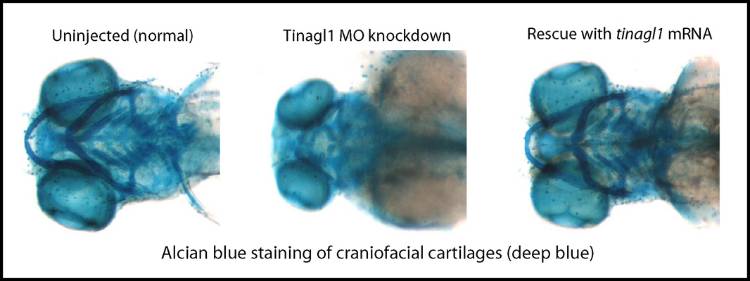
Knocking the zebrafish protein out (CRISPR/Cas9 mutant) or reducing its expression (morpholino oligonucleotides, MOs) results in similar defects, of which just two will be described here. Characterized so far just for the MO method, there are dose-dependent reductions in the craniofacial cartilages at 5 days of development, associated with earlier decreased dlx2a-expressing neural crest cells in the pharyngeal pouches by 1 day of development.
 Zebra Fish

We are following up hypotheses that neural crest cell proliferation or migration is affected, and that these defects arise via reduced Wnt signaling. A paper describing data leading up to these hypotheses is in press: Neiswender, H., Navarre, S., Kozlowski, D. J., and LeMosy, E. K. (2016) Early craniofacial defects in zebrafish having reduced function of a Wnt-interacting extracellular matrix protein, Tinagl1. Complementing preliminary data from Dheeraj Ravilla’s CURS project suggests that mutating a prospective Wnt-binding site in Tinagl1 can result in dominant negative effects on zebrafish development. 

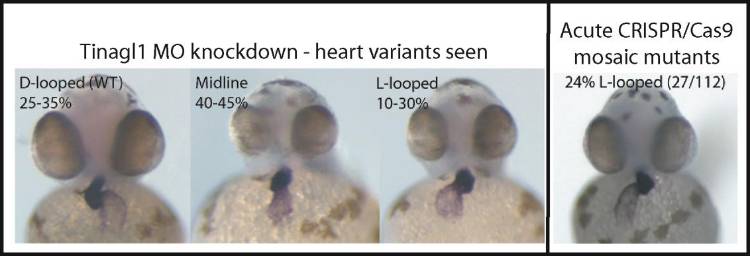
Interestingly, in both mutant and MO knockdown, we also see randomization of heart looping in the early embryo. This phenotype is a reflection of impaired establishment of the left-right (L/R) axis, not only in zebrafish but in mammals, where a classically described disease, Kartagener’s syndrome (aka primary ciliary dyskinesia), as well as numerous other genetic defects can result in failure to properly specify the L/R position of abdominal organs, lungs, and heart. We are working to identify the specific pathways that are affected by loss of this protein, and to understand how the heart looping defect relates to other phenotypes of this mutant.
Zebra Fish 2

Project Two: How do extracellular matrix carbohydrates and spatial cues regulate the activity state and localization of signaling molecules during fruit fly embryonic patterning?

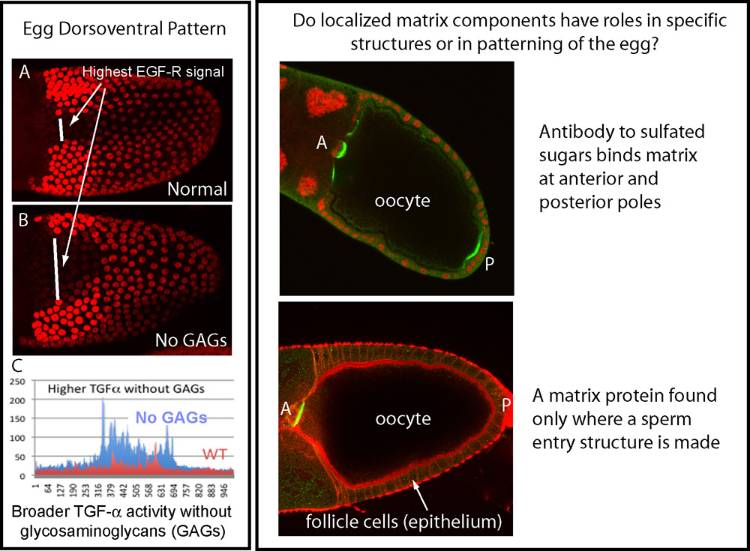
Signaling molecules similar to EGF and NGF sequentially determine dorsoventral polarity of the fruit fly oocyte and embryo. Much of our published work involves proteases that regulate activation of the NGF-related ligand in the embryo, but we have more recently gained biochemical and genetic evidence for roles of two classes of charged sugars, including GAGs (glycosaminoglycans), in spatial control of these ligands. This work may have implications for regulation of related signals important in cancer and nervous system. This project has benefited from collaborations with colleagues at the Complex Carbohydrate Research Center in Athens, GA, as well as with a laboratory at Scripps Research Institute in La Jolla, CA. For a motivated student, this project may offer experience with glycobiology and biochemistry, in addition to genetics and developmental biology.
Oocyte

University Shield

Augusta University

1120 15th Street, Augusta, GA 30912

  •   Campus Maps
  •   Campus Contacts
  • A-Z Directory
  • Degrees & Programs
  • Employment
  • Accessibility
  • Accreditation
  • Campus Safety
  • Compliance Hotline
  • Human Trafficking Notice
  • Privacy Notices
  • Title IX / Sexual Misconduct
Apply Now Give Now

© 2025 Augusta University

Facebook Twitter LinkedIn Youtube Instagram
©