Program History
The department of Art as Applied to Medicine was established in April 1948 by Dr. G. Lombard Kelly, Dean of the School of Medicine of the University of Georgia. In 1950, the School of Medicine became a separate state institution, the Medical College of Georgia, and Dr. Kelly became its president.
Mr. Jack Wilson, who had trained under Max Broedel at the Johns Hopkins University, was appointed Professor and Director of the new department which had both an academic and a service unit. Prof. Wilson was a Charter Member of the Association of Medical Illustrators (AMI). His first student was George C. Lynch, who was enrolled in an experimental non-degree program. Prof. Wilson's immediate efforts were directed toward planning a curriculum which would warrant the awarding of the Master of Science in Medical Illustration degree. Bob Benassi, the first student in the approved graduate program, was admitted in September 1949. However, that same September, Prof. Wilson took an extended leave of absence. Wilson's Johns Hopkins classmate, Orville A. Parkes, also a Charter Member of the AMI, was appointed to fill in during his absence. Lynch left to fill Parke's vacated position at Duke University. When Wilson resigned later in the academic year, Parkes' appointment became permanent.
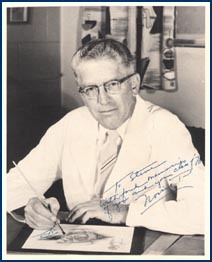
Through the additional efforts of Professor Parkes, the master's degree curriculum gained the approval of the Board of Regents in February 1950, and in the fall of that year, the name was changed to the Department of Medical Illustration. In June, 1951, the department, then in the School of Medicine, awarded its first Master of Science degree to Robert C. Benassi. Originally, the planned curriculum included a doctoral degree; however, the doctoral portion was not approved by the Board of Regents. In 1953, the curriculum was expanded from a two to a three-year course of study. During the first ten years, in addition to the graduate students, a few special students took the course of study and received a certificate upon completion.
In the early years, the department was located under the eaves on the top floor of the Newton Building, which at that time housed the entire School of Medicine. The students' clinical experience was gained in the nearby University Hospital. In 1956, upon completion of the Medical College's Eugene Talmadge Memorial Hospital, the department moved into new quarters in the Dugas Building. At this time a second faculty member was added; Richard Myers, a 1956 graduate of the program, was hired as an Instructor. Each of the following graduates in turn filled this position when they graduated: Al Allen, Jim Goodman, and Octavia Garlington. Tom Lanier, upon becoming Chief of Photography in 1959, also became Instructor of Photography. Growth of the department was slow during the first decade, with one or two degree students admitted each year. A total of 13 students were graduated by 1959.
During the second decade (1960 to 1969), as the institution expanded into a university, enrollment was increased to four students each year, and a total of 30 students graduated during this period. Upon her graduation in 1959, Frances DeRoller became medical illustrator for the Department of Neurosurgery, but (without appointment) taught the three-dimensional course. In 1962 Professor Parkes received approval from the Board of Regents to award a BS degree in Medical Illustration, the first bachelor's degrees being awarded in 1964 (This change was made in order to shorten the length of time required to obtain the Master's degree (seven years beyond high school)). It was anticipated that students would be accepted after two years of college, and after two more years in the medical illustration curriculum, a bachelor's degree would be awarded. With one further year of study, the master's degree would be awarded. Also in 1962, the School of Graduate Studies was established and the Department of Medical Illustration was placed under its administration. The medical illustration academic program and the medical illustration service unit were separated in 1967; the service unit became part of a new Division of Health Communication.
Also in 1967, the school became the first school of medical illustration to receive official accreditation from the Association of Medical Illustrators. The following year the academic department administratively was placed in the newly formed School of Allied Health Sciences with the third year curriculum remaining in the School of Graduate Studies. In 1969, enrollment increased to five students per class.
In the summer of 1971, the department moved next door into temporary facilities on the second floor of the Murphey Building where it remained for three years while the Dugas Building was being renovated. In planning the department's renovation, Parkes deigned spacious student cubicles for a projected maximum enrollment of twenty-four students (eight per class). David Mascaro joined the faculty during the "Murphey exile."
It had become evident by the early 1970's that the entrance requirements were above the abilities of most applicants having only two years of college; in ten years only four gained admission because applicants with two years of college could not compete against the superior qualifications of the many applicants who were college graduates. Rather than lower the standards, all three years of the curriculum were once again placed on the graduate level. In June 1974, the last BS degrees were awarded. The department remained administratively within the School of Allied Health Sciences while its curriculum and degree were within the School of Graduate Studies.
In June 1974, Orville A. Parkes retired after twenty-five years of service. During his administration the department had grown from a faculty of one to a faculty of three; enrollment had increased from one to six students per class; the physical space had doubled and a total of 65 students had graduated from the program.
Three months later the department moved back into renovated and expanded quarters in the Dugas Building. Paul J. Brucker, EdD was appointed Professor and Chairman of the department and head of the audiovisual media production services, with Octavia Garlington, Associate Professor, as Acting Director of the Medical Illustration Program. This administrative hierarchy was created because the institution was considering broadening the Department of Medical Illustration into a department of Bioscientific Communications with a doctorate as the terminal degree. Other than appointing the Chairman, the plan never was seriously pursued.
In April 1975, upon the appointment of William J. Stenstrom as Associate Professor and Director of the Graduate Program, the Department of Medical Illustration began the second phase in its history. Lewis Hinely was hired as dental illustrator and maxillo-facial prosthetist in the School of Dentistry in 1978.
In addition to strong leadership, Stenstrom brought energy, enthusiasm and new ideas to the program. The department's excellent collection of medical illustrations was initiated within a year after he arrived. It was not long after enrolling for graduate study in education that he was applying various aspects of his new knowledge to the medical illustration program. Under his direction, the entire medical illustration curriculum was examined and modified to assure that it included all of the knowledge, skills and experience required of an entry-level medical illustrator. Then the comprehensive examination was redesigned to have each student demonstrate these competencies prior to graduation. By 1985 there were eight students per class.
Stenstrom also felt that a masters degree did not warrant a three year course of study, so over a period of years various courses were modified or combined with others, while a few were dropped from the curriculum. Finally, in 1988, the curriculum of required coursework was shortened from three to two years.
In addition, Stenstrom conceived two innovative alternative masters' degree curricula in medical illustration: one, for someone with a bachelor's degree in medical illustration; another, for physicians and other qualified life scientists. Over the years he anticipated future needs for class content, equipment and materials, and then found ways to obtain them: computer literacy, student darkrooms within the department, visiting lecturers, a computerized typesetter, departmental television hardware, computer hardware and software. There was an ongoing "wish list" of anticipated future needs.
In 1989 shortly before attaining an Ed.D. degree in Curriculum and Administration, Professor Stenstrom was appointed Chairman of the Department of Medical Illustration. One of his first actions was to have Karen Waldo, Chief of Medical Illustration Services, appointed as adjunct faculty in the academic department.
In June 1990, Octavia Garlington, Professor in the department, retired after 30 years of service. Marsha Dohrmann was appointed to her position.
At the end of June 1991, Dr. William J. Stenstrom retired as Chairman of the department after sixteen years of outstanding service not only to the department, but to the university as well. One hundred and seven students were graduated during his tenure.
Since 1985, the school has been accepting eight students per class. Through the years the curriculum and the physical facilities have slowly but constantly changed. Computers have been added to the academic program and Carrie DiLorenzo, upon graduating from the program, received a faculty appointment to teach this specialized subject. The present competency-based curriculum is the result of years of thinking, discussing, planning and modifying with input from students, faculty, alumni and professionals.
In July 1991, a year after filling a faculty vacancy created by Octavia Garlington's retirement, Marsha Dohrmann was appointed Chairman of the Department. Steven J. Harrison joined the faculty later that same year, and became Acting Chairman when Ms. Dohrmann stepped down from that post in April 1993. He was appointed Chairman on January 1, 1994. In July 1995, John Foerster joined the Department faculty as an assistant professor and began to modernize the department's computer resources (an ongoing task).
In March 1999, the Department of Medical Illustration moved from the Dugas Building to newly renovated facilities in the Pavilion III (the old Out-patient Building). William M. Andrews joined the faculty as an assistant professor during the summer of 1999 to replace John Foerster, who returned to private practice. Associate professor David J. Mascaro retired at the end of June 2000, after 29 years of teaching and service to MCG. Lewis Hinley retired as well, following 22 years of service to the School of Dentistry.
John resigned in 2003 to pursue other interests. Andrew Swift resigned in 2010 to pursue personal interests. Michael A. Jensen joined the faculty in May 2011 as an Assistant Professor, filling the vacant faculty position.
In June 2011, Professor Steven Harrison, PhD stepped down as Chair, and Professor Andrews became Interim Chairman and Program Director. Dr. Harrison subsequently retired on October 31, 2011. Amanda Yarberry Behr joined the faculty in January 2013 as an Assistant Professor, bringing us back to a complement of three full-time faculty members.
By May 2014, the number of graduates since the school’s beginning totaled 350.
In August of 2015, Bill Andrews stepped down as Interim chair and Michael Iwama, Chair of the Occupational Therapy Department, was appointed Interim Chair. In May of 2016, Amanda Behr was appointed Interim Chair and became Program Director in July of 2016.
In August of 2018, Bill Andrews was named Chair, and Amanda Behr continued to serve as Program Director.
In 2021, the Medical Sculpture Core Lab was established with grant funding from the Georgia Rehabilitation Institute, Inc. This new facility enhances students’ access to 3D printing and medical sculpture techniques. Since its establishment, students and faculty have supported patient and provider education through anatomical teaching models and surgical simulation projects.
In May 2022, Bill Andrews retired, and Joseph Samson joined the faculty in March 2023 as an Assistant Professor, filling the vacant faculty position. Amanda Behr, PhD was named as the Chair, while Michael Jensen was appointed to be the Program Director, where they both continue to serve.
With the continued support from the College of Allied Health Sciences, funding was secured for a 4th full-time faculty member, and Mandy Root-Thompson joined the faculty in August 2025 as an Assistant Professor.
In 2025, the Medical Illustration graduate program was recognized for its excellence and innovative instruction by being awarded the Augusta University Teaching Excellence Award.
By May 2025, the number of graduates since the school’s beginning totaled 444.